Theodore Finch and Gabe Romero's antagonism
All the Bright PlacesTheodore Finch and Gabe Romero’s antagonism is a recurring conflict in which insults become physical attacks and Finch’s responses shift between restraint and dangerous retaliation. A confrontation by the river makes the pattern visible: Gabe provokes Finch, Finch answers with violence, and Violet Markey’s intervention is what finally stops him.
The River Confrontation
Gabe begins by asking Finch whether Finch had asked Violet a question, then calls him a slur. Violet snaps back that Gabe is looking for a fight and tells Finch not to make matters worse. Gabe continues, mocking Finch for being wet and making a crude joke about Finch’s mother. The taunts turn quickly into action: Gabe jumps on Finch, and they roll down the bank into the water.
Gabe strikes first, hitting Finch in the face and then repeatedly punching his mouth, nose, and ribs. Finch initially does not return the blows; he blocks them. The balance changes when Finch twists Gabe’s arm behind his back, plunges Gabe’s head underwater, and holds it there. Violet tells Finch to let go, but he does not respond. Ryan Cross grabs Finch by the collar of his black sweater and then by the arm, trying to pull him away, while Gabe’s legs thrash in the water.
Violet repeats her command. Finch looks at her as though, for a moment, he does not recognize her. She sharpens the order, and he releases Gabe. Finch then lifts him from the water and drops him onto the bank, where Gabe coughs up water. Finch walks up the hill without looking back, his face bloody. The scene ends not with a reconciliation but with Finch’s sudden withdrawal; Violet skips returning to school and later rides to the Finch family home, following the confrontation beyond the riverbank.
Restraint and Escalation
The river encounter continues to shape Finch’s response after the fight is over. In the locker room, with Charlie Donahue gone, Mr. Kappel in his office, and the remaining students keeping their distance, Gabe corners Finch and threatens him, calling him a freak. Finch wants to attack, but he stops himself for two reasons: Gabe is not worth getting into trouble over, and he remembers Violet Markey ordering him to let Gabe go at the river.
Finch makes restraint deliberate and physical. He counts from one to five and tells himself he will hold back rather than punch Gabe. The decision does not erase the hostility between them; it shows how the earlier confrontation has given Finch a specific memory to use against his impulse to retaliate.
The next morning, after gym, Gabe passes Finch and mutters the same insult. This time Finch says he does not think before acting: he drives Gabe against a locker and chokes him, continuing even as Charlie tries to pull him away and Mr. Kappel arrives with a bat. Finch becomes absorbed in Gabe’s changing appearance, while his thoughts turn accusatory, assigning Gabe responsibility for having put him in this situation.
It takes four people to pull Finch off. As he is dragged away, he locks eyes with Gabe and warns that Gabe will never call him that again. The contrast with the locker-room encounter is stark: Finch had recently managed to count and stop himself, but the repeated insult now triggers an assault severe enough to bring school discipline. Their antagonism is therefore not simply a cycle of taunts and fights; it exposes the precariousness of Finch’s self-control, even as his earlier choice to listen to Violet shows that another person’s intervention can remain with him.
Repetition, Naming, and Point of View
The conflict is shaped not only by what Gabe Romero does to Finch, but by the recurrence of the insult that defines him as a freak. At the river, Violet Markey narrates the confrontation from close enough to register her battering heart and uncertainty about what will happen; her repeated command becomes the immediate force that ends the danger. Later scenes shift into Finch’s own account, where the same verbal provocation meets two different responses: in the locker room, he counts and consciously holds back, while the next morning he describes acting before he thinks. This change in narration makes restraint look less like a settled victory than a moment-by-moment effort. Finch’s final warning as he is pulled away gives the insult a lasting consequence: he makes clear that he will not accept being called it again, but the means of refusing it leaves Gabe choking and Finch facing discipline. The relationship remains unresolved, caught between the possibility of restraint and the physical danger of retaliation.
Witnesses and Intervention
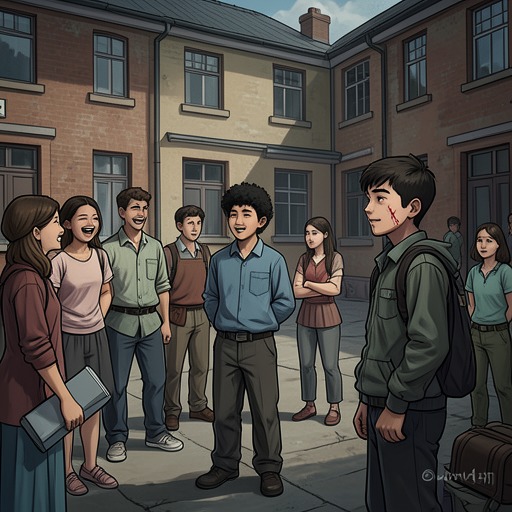
The confrontations unfold in public, but the presence of other people does not initially make them safer. At the river, Joe and Ryan stand by while Gabe attacks Finch; only after Violet presses Ryan to act does he try to pull Finch away. In the locker room, the remaining students recede rather than intervene when Gabe corners Finch. The next morning, by contrast, Charlie and Mr. Kappel try to stop Finch, and several people are needed to drag him away. Across these scenes, the conflict is shaped not only by what Gabe and Finch do to each other, but by whether anyone present can—or will—interrupt the violence. Violet’s command at the river proves decisive once Finch recognizes her, while the later assault requires collective physical force to end.